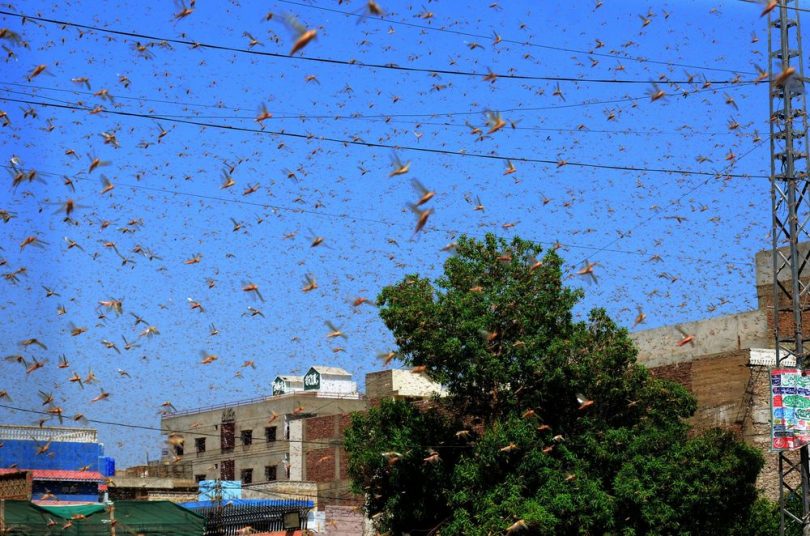
Agriculture sector accounts for 20% of Pakistan’s economy Some provinces diverting resources from virus to fight locusts
Swarms of locusts spreading across Pakistan are emerging as a bigger threat to the economy than the coronavirus pandemic, with the pests threatening farm output, livelihoods and food security.
The locust-invasion now covers an area of 57 million hectares in a country with a total crop area of 23 million hectares, said Falak Naz, director general of crop protection at the Ministry of Food Security and Research. While not all the areas infested now are crop lands, the insects are moving fast, he said.
Agriculture is the second-biggest sector in the economy — contributing about 20% to gross domestic product — and provides a livelihood to half of the nation’s workforce. Faced with devastating losses, authorities are now being forced to divert money set aside to fight the coronavirus to help combat the locust scourge instead.
From wheat to pulses and oil-seeds to mangoes, crops have already been damaged. The nation’s new cotton crop is seen as the most vulnerable to the pest attack — and with cotton-based products making up about half of Pakistan’s exports, the damage will further worsen the outlook for an economy forecast to shrink for the first time in 68 years.“This is a bigger problem than the coronavirus for Pakistan,” said Ahmad Jawad, a fruits exporter and an adviser to the Federation of Pakistan Chambers of Commerce & Industry, the nation’s main business lobby group. “You can save yourself from coronavirus by maintaining social distance, but there’s no escaping a hunger crisis if the locusts attack.”
Pakistan had a locust attack last year that arrived from Iran, but this year’s one is the most severe in three decades. Swarms of desert locusts occur irregularly in North Africa, the Middle East and South Asia, usually when drought is followed by heavy rain.
The threat comes just as Pakistan exits a lockdown that was imposed to contain the Covid-19 pandemic, with authorities now having to step up support for agriculture.
Murad Ali Shah, the chief minister of Sindh province — Pakistan’s second-largest crop-producing region — ordered the release of 132 million rupees ($807,000) his government had earlier kept for coronavirus emergency measures. He also approved another 286 million rupees for the purchase of chemicals and 25 pesticide-spraying vehicles.
In Sindh, locusts have damaged wheat, oil seeds, pulses, fodder and vegetables in an area of more than 166,701 hectares or 13.8% of the province’s total cropping area. Also at risk are cotton, sugarcane and other crops sown over more than 1.75 million hectares.
The government is using four aircraft and half-a-dozen army helicopters for crop dusting, and is planning to buy six planes from Air Tractor Inc., the food ministry’s Naz said. Farmers are using methods like beating drums and revving tractors to scare away the locusts that move about 90 miles an hour and eat any produce in their sight.
The infestation is capable of wiping out 40% of Pakistan’s major crops, according to Ahsan Mehanti, chief executive officer at Arif Habib Commodities, part of the fertilizers-to-financial services conglomerate Arif Habib Corp. Ltd.
“This is a major threat,” Mehanti said. “Pesticides should be procured to completely eradicate the locusts and save the crops.”
Comments
Post a Comment